Andy Smart
This is the first in a short series of reflections on the language of education for development.
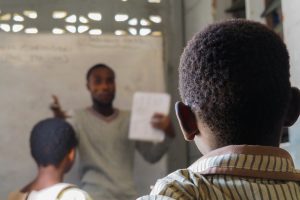
Photo by David Geneugelijk on Unsplash
I was curious when I first heard of structured pedagogy. It may have been around 2017 when the term seemed suddenly to be current. The term is even included in the 9 Principles that NISSEM published at the time of our launch in early 2018.
Structured pedagogy combines two words that had not previously been linked in the discourse of global education agencies. Since its first appearance the term has continued to gain currency in English. Other than in some majority languages[1], it is rarely rendered in other languages.
The term probably owes more than a little to ‘structured literacy’, coined in 2014 by the US-based International Dyslexia Organization to market an approach to early grade literacy.[2] However, although structured literacy may be a way of describing a pedagogy, structured pedagogy is often described more broadly as a multi-pronged initiative for systemic improvement.[3] The Global Evidence in Education Advisory Panel (GEEAP) defines structured pedagogy as ‘an instructional model that integrates teaching materials with lesson plans, student materials, in-service teacher training with follow-up support, and aligned initial teacher education’[4] and describes it as a ‘good buy’, meaning that investment in this area is likely to bring a good return in terms of learning outcomes.
When used in this way, the discourse confronts an awkward situation: claims are made for the effectiveness of an intervention that consists of too many variables to be capable of measurement in a precisely designed RCT. At the same time, the many prongs of such interventions in contexts that typically have few resources may demonstrate only the unsurprising conclusion that providing a wide range of resources can make a difference to outcomes.
Even when used more narrowly to describe an approach to early grade literacy or numeracy, the GEEAP description typically conceals more than it reveals.
I should be clear: I have no issue with structure or with pedagogy. On the contrary: my career as a textbook publisher and – more recently – as a textbook developer has shaped my thinking about the benefits of a well-structured textbook based on ‘good’ pedagogy to support improved teaching and learning. But what kind of structure and what kind of pedagogy?
Robin Alexander’s widely-cited definition of pedagogy describes it as …
… the observable act of teaching together with its attendant discourse of educational theories, values, evidence and justifications. It is what one needs to know, and the skills one needs to command, in order to make and justify the many different kinds of decisions of which teaching is constituted.[5]
Alexander goes on to say that ‘Pedagogy … encompasses both the act of teaching and its contingent theories and debates. Pedagogy is the discourse with which one needs to engage in order both to teach intelligently and make sense of teaching – for discourse and act are interdependent, and there can be no teaching without pedagogy or pedagogy without teaching.’ This description – based on teaching with understanding – lies at some distance from the GEEAP definition and the global-facing ‘what works’ movement in the field of education and development.
Any curriculum or materials developer can point to evidence of structure and pedagogy in their own teaching and learning resources. All textbooks by definition have a structure of units or chapters, lessons or topics, that follow a sequence of headings and activities. For the writer, this sequence represents a teaching methodology. What is often lacking is how the materials can help develop the teacher’s theories, values, and evidence, such that the teachers themselves can better provide justifications for how they teach.
Good teaching and learning resources should support rather than constrain good teaching practice. Resources that are transparent and supportive in terms of pedagogy provide a basis for organizing teachers’ professional development. Teachers – and the materials writers themselves – who understand the underlying pedagogy find it easier to adopt new practices.
What does this have to do with NISSEM?
NISSEM has three pillars: the pro-social and pro-societal themes and values of Target 4.7, the social and emotional dimensions of education, and the role of educational materials in centralized and low resource settings.
Educational materials can light the way for changes in classroom practice, or as a co-authored chapter in NISSEM Global Briefs Volume 5 puts it, provide a ‘path through the curriculum forest’.[6]
For NISSEM, the social and the emotional dimensions and purpose of education are as important to good pedagogy as the teaching of knowledge and skill. For a teacher, these dimensions make sense of teaching and learning as relational acts between teacher and students and between students themselves. The dimensions underpin the theories, values, evidence, and justifications for how teachers teach. For students, these dimensions and relational acts add meaning to their experience of being at school.
In textbook-centered school classrooms of the Global South, the organizational structure of a textbook is practically a given. What counts is how the textbook and accompanying teacher’s guide support teachers and students to jointly engage in relational pedagogy.
[1] In French and Spanish, the term is usually translated respectively as pédagogie structurée or pedagogía (or enseñanza) estructurada, which are much less widely used than the English term.
[2] See https://dyslexiaida.org/structured-literacy/ and https://va.dyslexiaida.org/what-is-structured-literacy/. Even those who would not normally be considered part of a progressive commentary have attempted to make clear that what may be appropriate for dyslexics is not necessarily appropriate for all. https://www.seidenbergreading.net/blog/on-structured-literacy-in-the-science-of-reading
[3] I have written elsewhere on the catch-all character of structured pedagogy in educational interventions in low- and middle-income countries: https://iartemejournal.org/index.php/IARTEM/article/view/971
[4] https://www.worldbank.org/en/topic/education/brief/global-education-evidence-advisory-panel
[5] http://robinalexander.org.uk/wp-content/uploads/2019/12/IHCE-chapter-59-Alexander.pdf
[6] https://nissem.org/wp-content/uploads/2026/01/NGB-Volume5.pdf