By Adeel Abid (Author: Peacebuilding through Storytelling)
 In a world flooded with divisive narratives and misinformation, stories that promote empathy and understanding are more essential than ever. So, how do you equip someone with the skills to earn a living while also empowering them to become agents of change?
That was the heart of Peace Train, a seven-month online training program that brought together nearly 100 aspiring young creatives from across Pakistan. The goal was simple yet powerful: To teach youth technical skills like 3D Animation and Unreal Engine while also showing them how to pair those skills with the art of storytelling to promote peacebuilding and unity.
Delivered free of cost to students nationwide, Peace Train was more than just another vocational course. It gave young people the tools and confidence to tell meaningful stories that inspire change.
Blending Creative Training with Social Purpose
Peace Train offered students two creative tracks depending on their background and interests. 3D Character Animation and Unreal Engine. Regardless of their technical path, all students received dedicated training in storytelling and peacebuilding, learning how to build narratives with emotional impact and social relevance.
Training sessions encouraged students to reflect on personal and societal challenges that create discord (such as misinformation, intolerance and inequality) and reimagine them through creative storytelling.
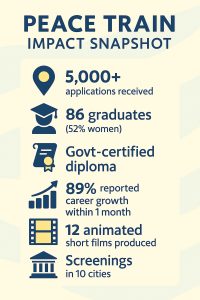
The response to the program was overwhelming. 5,000 plus students applied from across Pakistan, from the bustling cities of Karachi, Lahore, and Islamabad to more remote and conflict-affected areas including Sukkur, Quetta, and Waziristan. The cohort was diverse, and despite 73% of applicants being male, over half the graduates were women, a testament to our commitment to inclusion.
Graduates received a government-recognized diploma through Pakistan’s Trade Testing Educational Authority (TTEA), marking both their creative and academic achievement.
From Learners to Storytellers
At the heart of the program were the stories that students created. Working in teams, they produced 12 animated short films, each conveying a message of empathy, courage, or reconciliation. In the early stages, many students leaned toward overtly moralizing narratives. Understandable, given the sensitive themes they were tackling. But through guided mentorship, peer critique, and an emphasis on character development and emotional nuance, their stories began to shift. They learned to build layered narratives that didn’t just preach, but moved and provoked thought. For the goal wasn’t just to produce polished animations, but to craft stories that could start conversations, challenge assumptions, and foster empathy.
These stories weren’t abstract concepts. They reflected real tensions, challenges, and aspirations that young people experience in their communities. The animation opened up dialogue in ways few other mediums can.
One of the most powerful outcomes was the shift in students’ perspectives. While many were initially hesitant to acknowledge discrimination or bias in their own communities, through group discussions and storytelling exercises (such as asking them to narrate their own “Story of You by 2030” or crafting responses to real-life examples of hate speech), they began to confront these issues and saw how their creative work could promote empathy and inclusion.
From Screen to Society
After the program, the animated films were screened in schools and colleges across ten cities in Pakistan. These sessions sparked open discussions on themes like tolerance, misinformation, and the power of youth-led storytelling to drive change.
Audience feedback showed overwhelming agreement that the stories were effective, relevant, and inspiring.
Notably, within just one month of the program’s completion, 89% of students reported that it had significantly contributed to their career growth, whether through new jobs, promotions, or freelance opportunities. But the program’s real innovation lay in how it wove social impact into a technical skill-building course. Instead of treating empathy, peacebuilding, and inclusion as add-ons, these values were embedded into the storytelling lessons. This intentional integration ensured that civic themes such as representation, tolerance, and inclusion weren’t isolated lessons, but part of the students’ creative identity.
In doing so, Peace Train offered a model for how SDG-aligned values can be meaningfully embedded in education and training. The result: a cohort of young professionals not only equipped with marketable animation skills, but also with the mindset to use those skills for social good. This kind of value-based training creates a multiplier effect, enabling graduates to carry forward the principles of empathy and equity into diverse professional and community contexts.
The insights and frameworks used in Peace Train also shaped my book, Peacebuilding through Storytelling, which explores how narratives can promote empathy, counter hate, and build more inclusive communities.
We’ve led discussions and workshops on how storytelling can be used in the classroom to build civic values, emotional intelligence, and critical thinking.
This full-circle approach, from hands-on training and content creation to curriculum-linked materials and educator outreach, is what makes Peace Train more than a one-off initiative. It’s a scalable, replicable model for integrating creativity, critical thinking, and peacebuilding in meaningful ways.
Moving Forward
I recently launched Elemental Studios, a creative agency that uses storytelling to tackle social challenges. From developing animated content to designing learning tools and awareness campaigns, our mission is rooted in empathy, inclusion, and purposeful communication.
But at the core, it all starts with helping young people discover their voices and learn how to use those voices to tell stories that matter.
Final Thoughts
Peace Train proves that with the right support, even novice storytellers can produce deeply moving, socially relevant content. It also shows that storytelling is not an abstract skill. It’s a civic responsibility. A well told story can challenge bias, dissolve fear, and build connections.
We’re continuing to share this model and the tools behind it with educators, youth leaders, and institutions across Pakistan and beyond. If you’re interested in using storytelling to build peace, we’d love to connect.
Because peace begins with a story. And stories begin with those brave enough to tell them.